The Pillow Height Test That Changed How I Judge Neck Pain Relief
 Jordan HaleStaff Writer
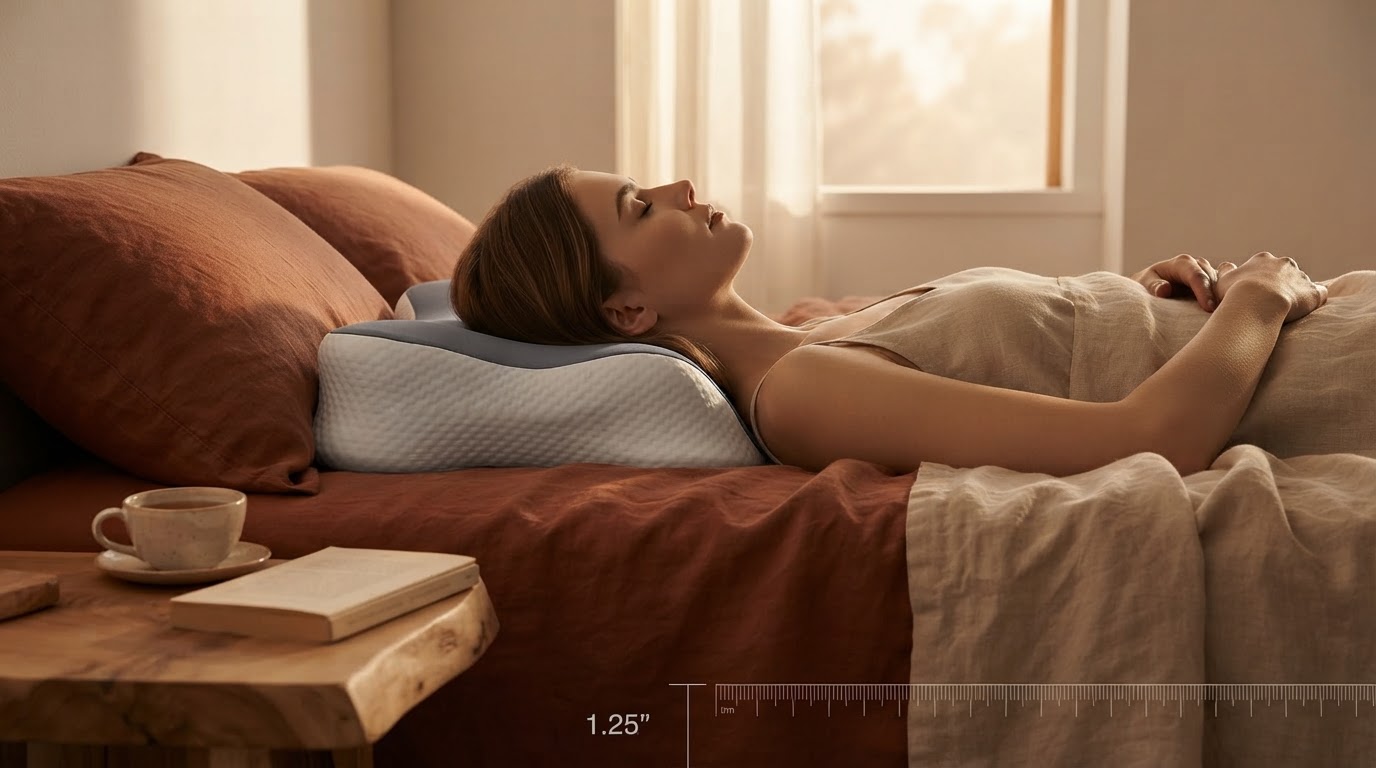
I stopped judging cervical pillows by “soft” or “firm” after one repeated observation: in my own side-sleep setup, a 1.25-inch height change was enough to turn a calm neck into a stiff one by morning.
That number sounds too small to matter until you see it in profile. On a side sleeper, the pillow is not just cushioning the head; it is filling the gap from the mattress surface to the side of the face while the shoulder compresses into the bed. If that gap is off by even an inch, the neck spends hours either side-bent upward or dropping toward the mattress.
I sell and use memory foam cervical pillows, so I have heard plenty of buyers ask the obvious question: “Will this help my neck pain?” The more useful question is usually narrower: “Does this pillow hold my neck close to neutral in the position I actually sleep in?” That is the field observation that changed how I evaluate every pillow now.
The non-obvious problem: the pillow is usually blamed for the mattress
When someone tells me a cervical pillow “felt too high,” I do not assume the pillow is wrong. I ask what mattress they used it on.
A medium-firm mattress that lets the shoulder sink 1.5 inches creates a very different pillow requirement than a firm mattress where the shoulder barely sinks at all. The same person can need a taller loft on the firmer surface and a lower loft on the softer one. This is why a pillow that feels perfect at a hotel can feel wrong at home.
There is research behind the idea that pillow choice can affect symptoms, though it is not magic. A randomized controlled trial published in The Journal of Pain Research looked at a spring pillow and neck pain outcomes, while other clinical literature indexed by NIH has examined how pillow shape and support affect cervical symptoms. The big practical takeaway I see is not “one pillow fixes everyone.” It is that support, height, and sustained posture matter.
NIH’s MedlinePlus also gives the plain-language version of the same advice for neck pain: maintain good posture, avoid awkward positions, and support the neck during sleep. That sounds basic, but it is exactly where pillow buying often goes wrong. People shop by feel in their hand instead of spinal position under load.
My five-minute pillow height test

Here is the test I use before I decide whether a cervical pillow is likely to work for me. You need a phone camera and a folded towel.
For side sleeping, I look at the line from the center of the back of the head to the upper spine. If the head tilts toward the ceiling, the pillow is too high. If the head drops toward the mattress, it is too low.
For back sleeping, I look for a different problem: chin angle. If my chin is pushed toward my chest, the pillow is too thick under the head. If my chin points up and my throat feels stretched, the neck roll is not supporting the cervical curve enough.
A good memory foam cervical pillow should let the head nest slightly while the neck roll carries the curve of the neck. The head should not feel like it is perched on a block.
What I measured on my own bed
These are not lab results; they are practical observations from my own setup and repeated customer fit conversations. I measured pillow loft after 90 seconds of body weight settling, because uncompressed height is not what your neck experiences overnight.
| Setup I tested | Uncompressed loft | Loft after 90 sec | What I felt by morning | My fit note | |---|---:|---:|---|---| | Flat old polyfill pillow | 4.7 in | 2.6 in | Neck felt collapsed on side | Too low after compression | | Tall firm foam block | 5.2 in | 4.8 in | Pressure under jaw, head tilted up | Too high for my mattress | | Contoured memory foam cervical pillow | 4.3 in at neck roll | 3.7 in | Better side alignment, less morning stiffness | Closest fit | | Same cervical pillow + folded towel | 4.8 in effective | 4.2 in | Slight upper-neck tension | Towel made it too high | | Thin travel pillow | 3.1 in | 2.8 in | Fine for back, poor for side | Position-specific only |
The surprising part was how bad the “comfortable” polyfill pillow performed after compression. It felt cozy for the first minute. By morning, it had let my head drift downward enough that my neck muscles were working when they should have been quiet.
Memory foam is not automatically better, but it has one advantage I care about: predictable slow compression. A well-shaped cervical pillow compresses, but it does not usually disappear under the head the way loose fill can.
Why cervical shape matters more than foam density alone
Foam density is easy to market and hard for shoppers to interpret. A dense pillow can still be the wrong shape. A soft pillow can still support well if its contour matches your anatomy and mattress.
A cervical pillow usually has a raised neck roll and a lower head cradle. That design tries to solve two separate jobs:
- support the cervical curve under the neck;
- allow the back of the head to settle without forcing the chin forward.
The International Organization for Standardization’s ergonomics work, including ISO 11226 on evaluation of static working postures, is not a pillow standard, but it reinforces a principle that transfers well: sustained non-neutral postures increase strain risk. Sleep is a long-duration posture. If you hold a tilted neck for six or seven hours, small angles start to matter.
My take: the first night is not the verdict
My take: a cervical pillow should usually be judged over 5 to 10 nights, not one night, unless it causes sharp pain, numbness, or obvious worsening.
That is counter to what you will read in many quick pillow reviews. People often decide after one sleep. I understand why; a new contour can feel unfamiliar. But unfamiliar is not the same as wrong. When I switch from a flat pillow to a contoured one, I often notice the neck roll for the first two nights. By night four or five, I stop noticing it if the height is correct.
The exception is nerve-type symptoms. If a pillow triggers radiating arm pain, tingling, hand numbness, dizziness, or severe headache, I would stop using it and talk with a clinician. Pillows can help with positioning, but they are not a diagnostic tool and they do not replace medical care.
The decision framework I use before recommending a cervical pillow
I use four questions.
1. Do you sleep mostly on your side, back, or stomach?
Side sleepers usually need more loft than back sleepers because the pillow must bridge the shoulder gap. Back sleepers often need a lower head cradle and a defined neck roll. Stomach sleepers are the hardest fit for a cervical pillow because the neck is rotated for long periods. If someone is committed to stomach sleeping, I usually suggest working toward side sleeping gradually rather than expecting a pillow to cancel out the rotation.
2. Is your mattress firm, medium, or soft?
On a firm mattress, the shoulder stays higher, so a side sleeper often needs a taller pillow. On a soft mattress, the shoulder sinks, reducing the gap. This is why body weight also matters: a heavier shoulder on a plush mattress may sink enough to require less pillow height than expected.
3. Where is the pain in the morning?
Pain at the base of the skull can come from too much extension or pressure near the upper neck. Pain across the upper shoulders often points to side bending or poor shoulder positioning. Jaw pressure can indicate too much height on side sleeping. A stiff front-of-neck feeling on the back can mean the chin was pushed forward.
4. Does the pillow keep its shape under heat?
Memory foam softens with warmth. That is normal. The question is whether it softens into support or collapses into a ramp. I like to lie on a pillow for at least 10 minutes before judging it because the first 30 seconds do not tell the full story.
How to set up a memory foam cervical pillow at home

Photo by Kindel Media on Pexels
Use this checklist the first week:
- Start with the lower contour if the pillow has two neck-roll heights. Many people overestimate how much loft they need.
- Give the foam time to expand fully. If it arrives compressed, let it air out and recover before the first serious test.
- Align the neck roll with the hollow of your neck, not the back of your skull. This is the most common placement mistake I see.
- Do not stack another full pillow underneath. If you need more height, test with a thin folded towel first.
- Check your shoulder position. Side sleepers should not have the lower shoulder jammed forward under the chest.
- Reassess after night three and night seven. Look for a trend, not a single dramatic night.
- Stop if symptoms become neurological. Tingling, numbness, arm weakness, or worsening radiating pain deserves medical guidance.
Who is most likely to notice a difference?
In my experience, cervical pillows help the most when the pain pattern is clearly sleep-position related: you feel worse on waking, loosen up during the day, and can reproduce discomfort when your head tilts on the pillow. They are less predictable when pain is constant, injury-related, inflammatory, or associated with nerve symptoms.
The American Academy of Orthopaedic Surgeons notes that neck pain can come from muscle strain, arthritis, disc problems, or injury. That matters because a pillow can improve mechanical positioning, but it cannot reverse every cause of pain. I am careful not to oversell it. A pillow is a support tool, not a cure.
Still, support tools can be meaningful. If the wrong pillow is asking your neck muscles to stabilize your head every night, changing that input can reduce one recurring stressor. That is the realistic promise I am comfortable making.
What I would choose if I had to start over
If I were buying again for neck pain relief, I would not start with the thickest pillow or the firmest foam. I would start with a contoured memory foam cervical pillow that has:
- a defined neck roll;
- a lower head cradle;
- enough width to roll slightly without falling off the contour;
- medium response foam that compresses slowly, not instantly;
- a breathable, washable cover;
- a trial period long enough for a week of adjustment.
FAQ
Can a memory foam cervical pillow actually relieve neck pain?
It can help some people, especially when their pain is aggravated by poor sleep posture. The mechanism is positioning: keeping the cervical spine closer to neutral and reducing sustained muscle strain. It is not a treatment for every cause of neck pain. If symptoms include numbness, weakness, trauma, fever, unexplained weight loss, or severe persistent pain, I would seek medical care rather than relying on a pillow.
How high should a cervical pillow be for side sleeping?
There is no universal number because the needed height depends on shoulder width, mattress sink, and pillow compression. As a practical starting point, I look for the compressed pillow height to fill the shoulder-to-neck gap without tilting the head. In my own testing, a compressed loft around 3.7 inches worked better than 2.6 inches or 4.8 inches, but your number may be different.
Why does my new cervical pillow feel strange at first?
A contoured pillow contacts the neck differently than a flat pillow. If your old pillow let your head collapse or rotate, neutral support may feel noticeable for a few nights. Mild awareness is common. Sharp pain, radiating symptoms, or worsening headaches are not something I would push through.
Is memory foam too hot for neck pain sleepers?
Some memory foam pillows sleep warmer than fiberfill or latex because the foam contours closely around the head and neck. A breathable cover, ventilated foam, and a cooler room can help. I prioritize support first, then temperature, because a cool pillow that collapses still leaves the neck unsupported.