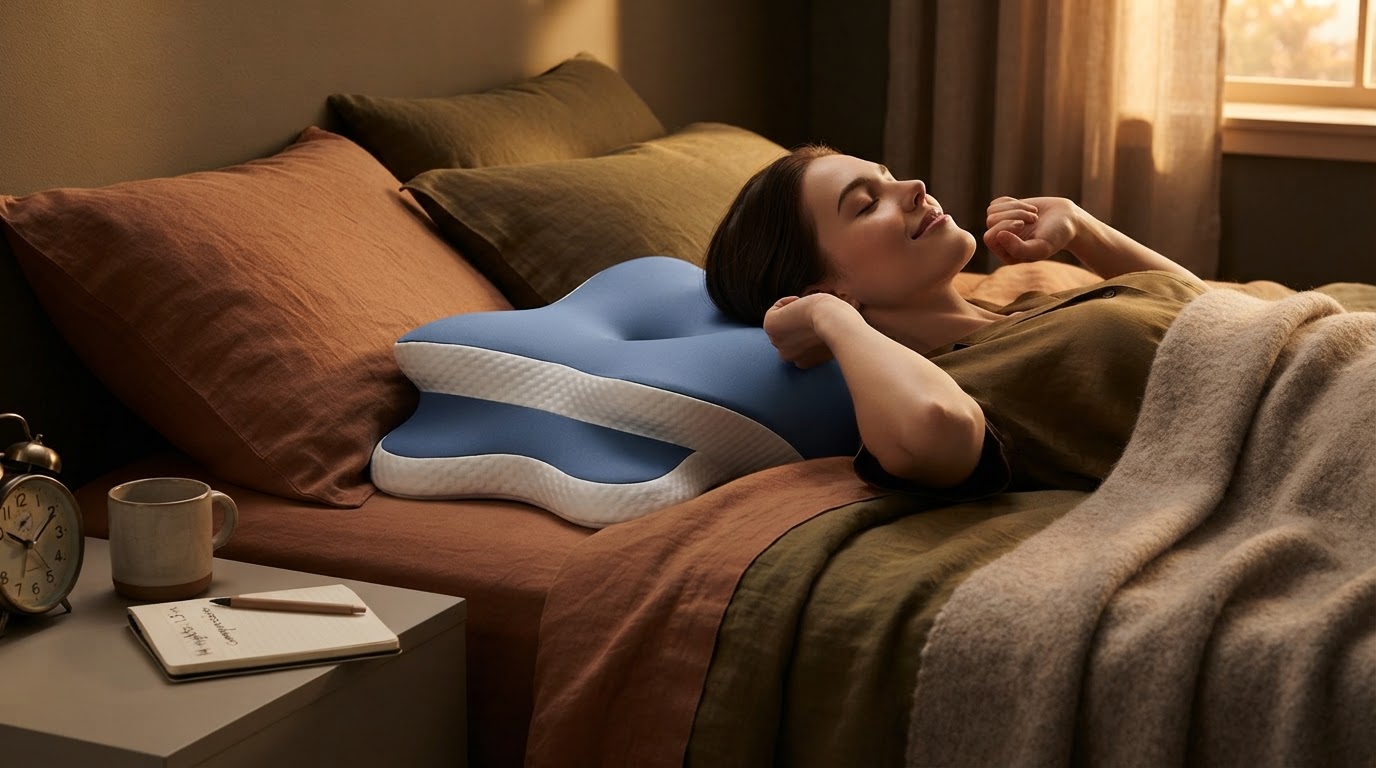
I Stopped Judging Neck Pillows by Softness After 14 Nights
 Jordan HaleStaff Writer
I changed my mind about cervical pillows after 14 nights and one boring measurement: the pillow that felt “medium-firm” in my hands compressed 1.3 inches more under my head than the one that actually reduced my morning neck tightness.
That number matters because most shoppers judge a memory foam cervical pillow the wrong way. They squeeze it in a store, read a loft number online, or look for the deepest-looking neck roll. I’ve done all three. But in real sleep, your neck does not care about catalog loft. It cares about the height and contour left after your head, shoulder width, mattress softness, and sleep position all load the foam for six to eight hours.
For cervicalneckpillows.com, where the focus is memory foam cervical pillow neck pain relief, my most useful advice is not “buy the firmest pillow” or “choose orthopedic.” It is this: measure the supported shape, not the advertised shape.
The non-obvious measurement I now use first
When I evaluate a cervical pillow, I look at compressed height in two places:
If the neck roll stays high but the head cradle sinks too far, I wake with my chin subtly tipped upward or my neck extended. If the head area stays high but the neck roll collapses, I get that unsupported “hammock” feeling at the base of the skull.
This is why memory foam can be helpful when it is shaped correctly. It spreads pressure and slows the collapse compared with loose fiberfill. But memory foam is not magic. Foam density, temperature, body weight, mattress give, and sleep position all change the final sleeping posture.
The broad clinical idea lines up with what neck pain guidelines emphasize: repeated positions and mechanical loading matter. The 2017 neck pain clinical practice guideline published in the Journal of Orthopaedic & Sports Physical Therapy discusses classification, exercise, and manual therapy rather than promising that any pillow alone cures neck pain. I like that because it keeps expectations honest: a pillow can reduce one source of irritation, but it is part of a bigger pattern.
My 14-night pillow log: what I actually observed

Photo by Gustavo Fring on Pexels
I tested three pillow setups at home on the same mattress: a standard fiberfill pillow, a low-loft memory foam pillow without a pronounced contour, and a contoured memory foam cervical pillow. I used the same bedtime routine and rated morning stiffness within 10 minutes of getting up. This was not a laboratory trial; it was a practical field check—the kind any buyer can repeat.
| Setup tested | Advertised or measured loft before lying down | Compressed head height after 5 minutes | Morning stiffness average, 0–10 | Notes I wrote down | |---|---:|---:|---:|---| | Fiberfill pillow, fluffed | 5.2 in | 2.7 in | 5.8 | Felt cozy at first, but neck roll disappeared by morning | | Flat memory foam pillow | 4.6 in | 3.4 in | 4.6 | Better pressure distribution, but my neck felt slightly unsupported on my back | | Contoured memory foam cervical pillow | 4.8 in high side / 3.9 in low side | 3.5 in head cradle, neck roll held at 3.9 in | 2.9 | Took 3 nights to adapt; fewer “first-turn” twinges in the morning |
Two details surprised me.
First, the fiberfill pillow looked taller than the cervical pillow at bedtime, but it lost its shape fastest. Second, the contoured pillow did not feel dramatically softer or more luxurious. Its advantage was boring: it held a more predictable geometry.
That matches a pillow study many shoppers never see. A randomized trial by Lavin and colleagues in Archives of Physical Medicine and Rehabilitation compared different pillows for people with chronic neck pain and found that pillow type could affect symptoms and sleep quality. It did not suggest that any pillow works for everyone, but it supports the practical point that pillow design is not just marketing.
Counter to what you’ll read elsewhere: softness is overrated
My take: the most comfortable cervical pillow on night one is not always the one that helps your neck on night seven.
I realize that sounds inconvenient. I sell people on comfort all the time in ordinary language because nobody wants a medical-looking brick under their head. But if I’m being honest, instant plushness can hide poor support. A pillow that lets the head sink pleasantly for 20 minutes may leave the lower cervical spine unsupported at 3 a.m.
For neck pain relief, I put “controlled compression” above “soft feel.” I want the foam to give enough to avoid pressure at the ear, jaw, and occiput, while still resisting total collapse under the neck curve. In a memory foam cervical pillow, that balance usually matters more than whether it feels cloudlike in your hands.
The decision framework I use before recommending a cervical pillow
I use a simple three-question framework. It keeps people from buying based only on height charts.
1. What position do you actually wake up in?
Your starting sleep position is less important than your repeated one. If you fall asleep on your back but wake up on your side every morning, you need side-sleep stability too.
- Back sleepers usually need a lower head cradle with a gentle neck roll. Too much height pushes the chin toward the chest.
- Side sleepers need enough compressed height to fill the shoulder-to-neck gap without tilting the head downward.
- Combination sleepers need a contour that does not trap the head so deeply that turning becomes awkward.
2. How soft is your mattress at the shoulder?
This is the part buyers miss. Pillow height and mattress firmness are a pair.
On a softer mattress, your shoulder sinks deeper. That can reduce the pillow height you need for side sleeping. On a firmer mattress, your shoulder stays higher, so the same person may need more pillow loft to keep the head level.
This is why two people with the same neck measurement can disagree completely about the same pillow.
3. Does the contour support the neck without forcing it?
A cervical pillow should guide the curve, not exaggerate it. I look for three signs that the contour may be too aggressive:
- You feel pressure directly under the base of the skull.
- Your chin points up when lying on your back.
- You wake wanting to shove the pillow away rather than settle into it.
A quick fit test you can do at home
You do not need lab equipment. A phone camera, a book, and five minutes are enough.
The side-sleep alignment check
I like using a door frame or vertical closet line in the background as a visual reference. It is not perfect, but it is better than guessing.
The back-sleep chin check
If the pillow makes you feel like you are reading a book on your chest, the head area is probably too high. If it makes your throat feel stretched, the neck roll or drop into the head cradle may be too aggressive.
What research can and cannot promise
The National Institutes of Health’s MedlinePlus describes neck pain as commonly related to muscle strain, posture, and sleeping in an awkward position, while also listing red flags such as weakness, numbness, fever, or pain after trauma. That distinction matters. A pillow can help with positional irritation, but it is not the right answer for neurological symptoms or injury.
A peer-reviewed systematic review in BMC Musculoskeletal Disorders has also noted that sleep disturbance and neck pain often travel together. I see that loop often: neck discomfort fragments sleep, then poor sleep lowers tolerance for pain the next day. A better pillow can break part of the loop if the pillow is one of the triggers.
But the evidence is not a blank check. Pillow studies vary in design, sample size, pillow type, and outcome measures. I do not claim that a memory foam cervical pillow cures chronic neck pain. I claim something narrower and more useful: a well-fitted contoured pillow can reduce mechanical irritation for some sleepers by improving overnight neck support.
That is the promise I am comfortable standing behind.
My practical cervical pillow checklist

Photo by https://kaboompics.com/ on Pexels
Before buying or keeping a memory foam cervical pillow, I run through this checklist:
- Give it 3 to 7 nights unless pain sharply worsens. A new contour can feel unfamiliar before it feels helpful.
- Measure compressed height, not just listed loft. Lie on it for five minutes and check alignment.
- Match the pillow to the mattress. Softer mattress usually means less side-sleep pillow height; firmer mattress may require more.
- Avoid extreme neck rolls if you are new to cervical pillows. Gentle support is easier to adapt to.
- Watch morning symptoms, not bedtime impressions. The real test is how your neck feels after hours, not minutes.
- Replace collapsed pillows. If the foam no longer rebounds or the contour has flattened, the support has changed.
- Do not ignore red flags. Arm weakness, numbness, severe headache, fever, or pain after a fall deserves medical attention.
Who may not love a contoured cervical pillow
I would rather be specific than overpromise. Some people struggle with cervical pillows.
If you sleep face-down most of the night, a contoured pillow can make rotation worse. Stomach sleeping already asks the neck to stay turned for long periods. A high contour can add extension to that rotation.
If you use a very soft mattress and have narrow shoulders, a high side-sleep edge may feel excessive. If you have broad shoulders on a firm mattress, the low side of a pillow may feel too thin. And if your neck pain is driven by inflammatory disease, nerve compression, or recent injury, pillow fit may only be a small piece of care.
That is not a failure of the pillow. It is a reminder that support is personal.
How I’d choose between the high and low side
Many contoured cervical pillows have two heights. My rule is simple:
- Start with the lower side if you are a back sleeper, smaller-framed, on a soft mattress, or new to cervical pillows.
- Try the higher side if you are a side sleeper, broad-shouldered, on a firm mattress, or waking with your head tilted downward.
FAQ
How long does it take to adjust to a memory foam cervical pillow?
In my experience, three to seven nights is a fair adjustment window. The contour changes where pressure and support occur, so the first night can feel strange. Mild unfamiliarity is normal; sharp pain, increasing headaches, arm symptoms, or worsening numbness is not something to “push through.”
Is a firmer cervical pillow always better for neck pain?
No. Firmness helps only if it preserves neutral alignment without creating pressure. A pillow can be firm and still too high, too low, or too aggressively curved. I care more about controlled compression and fit than firmness alone.
Can a cervical pillow help side sleepers?
Yes, but side sleepers need enough compressed height to fill the space between the mattress and the head after the shoulder settles. The common mistake is choosing a pillow that looks tall but collapses too much. A quick photo from behind can reveal whether your head is level with your spine.
When should I see a clinician instead of changing pillows?
Seek medical advice if neck pain follows a fall or accident, radiates with weakness or numbness, comes with fever, severe headache, unexplained weight loss, loss of coordination, or does not improve with reasonable self-care. A pillow is for positional support; it is not a diagnostic tool.